"WHATEVER YOUR
WAGES ARE,
SAVE A LITTLE."
His Young Life
Andrew Carnegie was born on November 25, 1835, in Dunfermline, Scotland, to William Carnegie, a weaver, and Margaret Morrison Carnegie. The invention of weaving machines replaced William Carnegie’s job and the family was soon in poverty. In 1848, when Andrew Carnegie was 13, the family left Scotland and settled in Allegheny City, Pennsylvania. After getting a job at a cotton factory, William Carnegie soon quit and begin to hand weave linens and trying to sell them door to door. Carnegie also worked in the cotton factory, but after his father died in 1855, he wanted to take care of his family so he decided to educate himself. He became an avid reader, a theatergoer, and a lover of music.
Once he was able to, Carnegie became a messenger boy for the Pittsburgh telegraph office, and later became a telegraph operator. When Carnegie was 18, Thomas A. Scott, the superintendent of the western division of the Pennsylvania Railroad, made Carnegie his secretary, and he was soon earning enough salary to buy a house for his mother. During the civil war, Scott became the assistant secretary of war in charge of transportation, and Carnegie took his place at the railroad when he was 26.
"People Who Are Unable To Motivate Themselves Must Be Content With Mediocrity, No Matter How Impressive Their Other Talents."
Forging the Future
Between 1865 and 1870 Carnegie made money through investments in several small iron mills and factories. He also traveled throughout England, selling the bonds of small United States railroads and bridge companies. Carnegie began to see that steel was eventually going to replace iron for the manufacture of rails, structural shapes, pipe, and wire. In 1873 he organized a steel rail company. The first steel furnace at Braddock, Pennsylvania, began to roll rails in 1874. Carnegie continued building by cutting prices, driving out competitors, shaking off weak partners, and putting earnings back into the company. He never went public , instead he obtained capital from profits,and when necessary from local banks, and he kept on growing, making heavy steel alone. By 1878 the company was valued at $1.25 million.
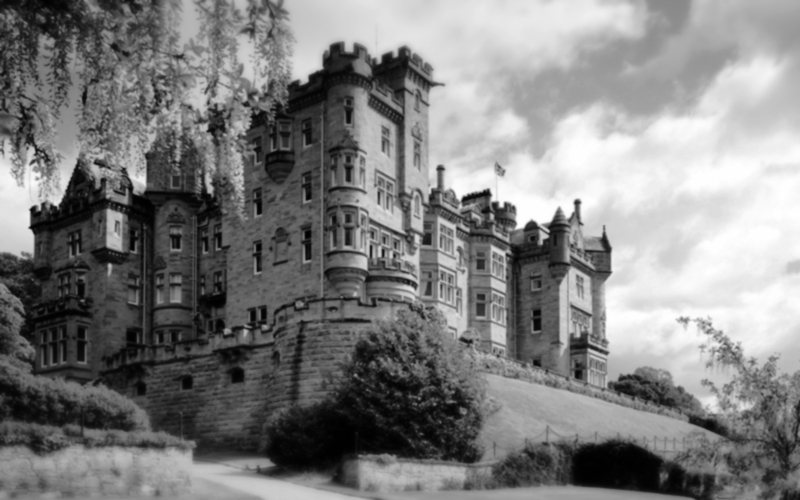
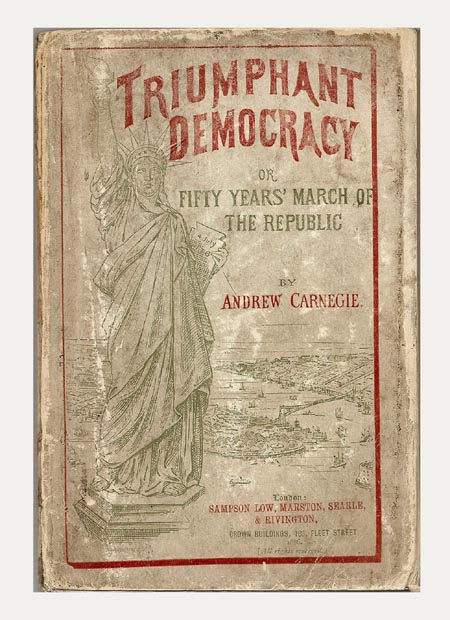
Carnegie spent his leisure time traveling. He also wrote several books, including Triumphant Democracy (1886), which pointed out the advantages of American life over the unequal societies of Britain and other European countries. To Carnegie access to education was the key to America's political stability and industrial accomplishments. In 1889 he published an article, "Wealth," stating his belief that rich men had a duty to use their money to improve the welfare of the community. Carnegie remained a bachelor until his mother died in 1886. A year later he married Louise Whitfield and they had one child together. The couple began to spend six months each year in Scotland, though Carnegie kept an eye on business developments and problems.
"I believe the true road to preeminent success in any line is to make yourself master in that line."
Carnegie's Philanthropy
In retirement, Carnegie began to set up trust funds "for the improvement of mankind." He built some three thousand public libraries all over the English-speaking world. In 1895 the Carnegie Institute of Pittsburgh was opened, housing an art gallery, a natural history museum, and a music hall. He also built a group of technical schools that make up the present-day Carnegie Mellon University; The Carnegie Institution of Washington was set up to encourage research in the natural and physical sciences; Carnegie Hall was built in New York City for music education and performances; The Foundation for the Advancement of Teaching was created to provide pensions for university professors. Carnegie also established the Endowment for International Peace to seek an end to war.
In all, Carnegie's donations totaled $350 million. The continuation of his broad interests was put under the general charge of the Carnegie Corporation, with a donation of $125 million. Carnegie donated most of his money by the time he died, he only left his property and a small portion of his fortune and donated the rest. Andrew Carnegie died on August 11, 1919, at his summer home near Lenox, Massachusetts.